
Getting Paid
How Your Customers Pay
A tour of the public pay page — UPI QR, bank transfer and card/net-banking — and how money reaches you directly with zero gateway fees.
Every invoice you send carries a secure pay link. When your customer opens it, they see a clean public pay page with the invoice and every way to pay you — UPI, bank transfer and (optionally) card or net-banking. Money lands directly in your own UPI or bank account.
What the pay page shows
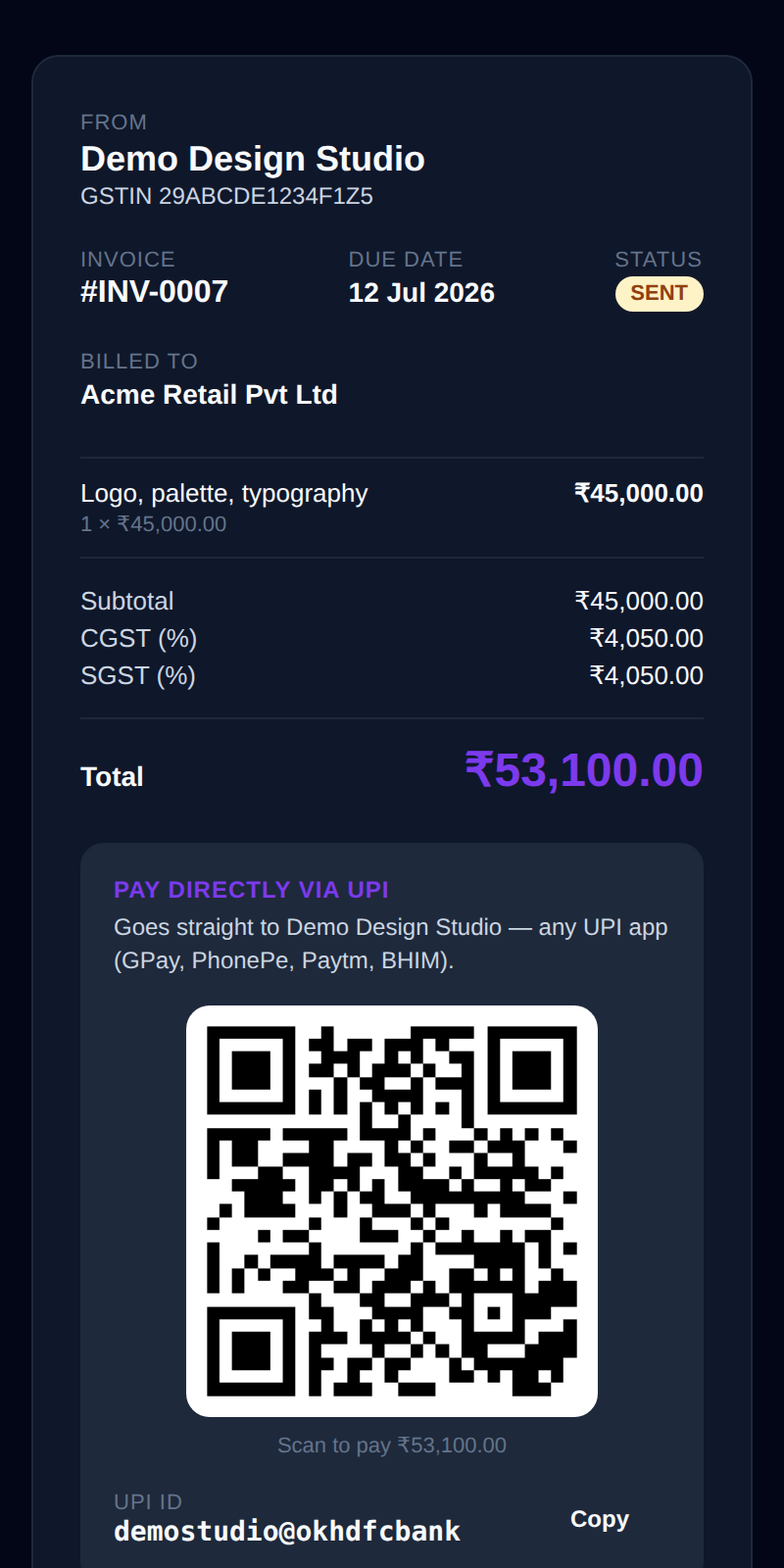
At the top, your customer sees the invoice details — your business name and GSTIN, the line items, GST breakdown and the total due. Below that are the ways to pay. Exactly which options appear depends on the payout methods you've set up.
Pay by UPI (direct)
UPI is the fastest option for most Indian customers. The pay page gives them three ways to pay by UPI, all pre-filled with the exact invoice amount:
- Scan the QR — a dynamic QR code with the amount already filled in. They scan it with any UPI app and confirm.
- Pay via UPI app — a button that opens GPay, PhonePe, Paytm or BHIM directly on their phone.
- Copy UPI ID — your UPI ID, copyable in one tap for customers who prefer to type it in manually.
Pay by bank transfer
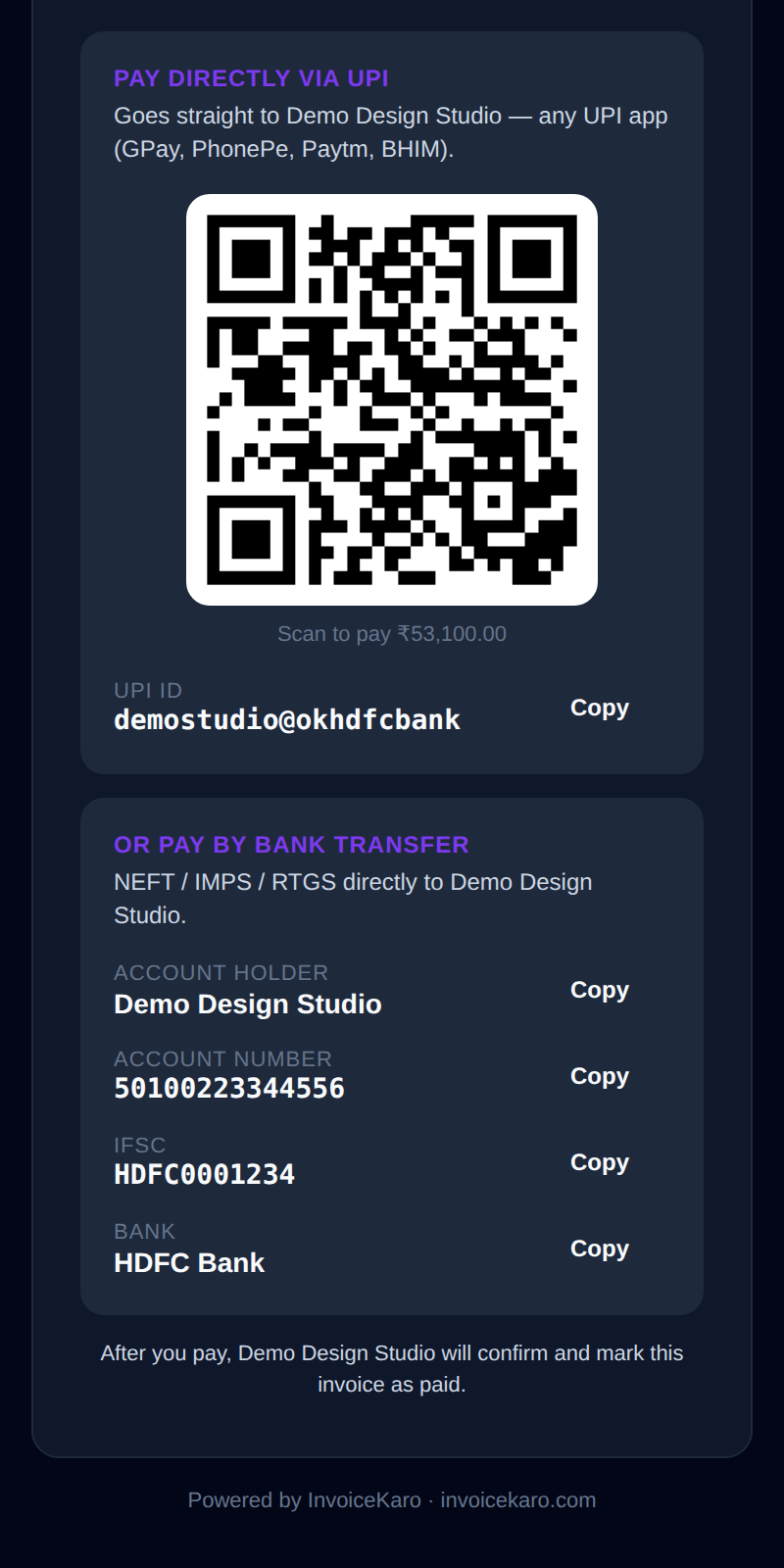
For customers who prefer NEFT, IMPS or RTGS, the pay page shows your bank details — account holder name, account number, IFSC and bank name. Each field is copyable in one tap, so there's no risk of a mistyped account number.
Card and net-banking
Card and net-banking isn't something you turn on. It appears only on older invoices that carry a legacy Razorpay gateway link, and even then only as a secondary *Or pay by card / net-banking →* text link. There's no self-serve toggle for it, and UPI and bank transfer remain the zero-fee, direct-to-you options.
Paid and expired states
The pay page changes to match the invoice's status:
| State | What the customer sees |
|---|---|
| Sent / overdue | The full invoice plus all your active ways to pay. A status pill shows the invoice's real status and turns red once it's overdue. |
| Paid | A clear confirmation that the invoice is settled — no payment options shown. |
| Revoked / expired | A simple message that the link is no longer active, with no payment details exposed. |