
GST & Compliance
GST Invoicing Explained
How InvoiceKaro handles per-item GST, automatic CGST/SGST vs IGST, GSTIN and the tax-breakdown shown on your PDF and pay page.
Every invoice you raise in InvoiceKaro is a proper GST tax invoice. You set the tax rate per item, and the app works out whether to split it into CGST + SGST or charge IGST — so you can focus on billing, not on tax arithmetic.
Set GST per item
GST is applied per line item, not per invoice, because a single bill can mix goods and services at different rates (0%, 5%, 12%, 18%, 28%). When you add a line on the invoice, set its GST % alongside the price, quantity and any per-item discount.
- 1Open the Invoices tab and start a new invoice (see Creating a GST invoice).
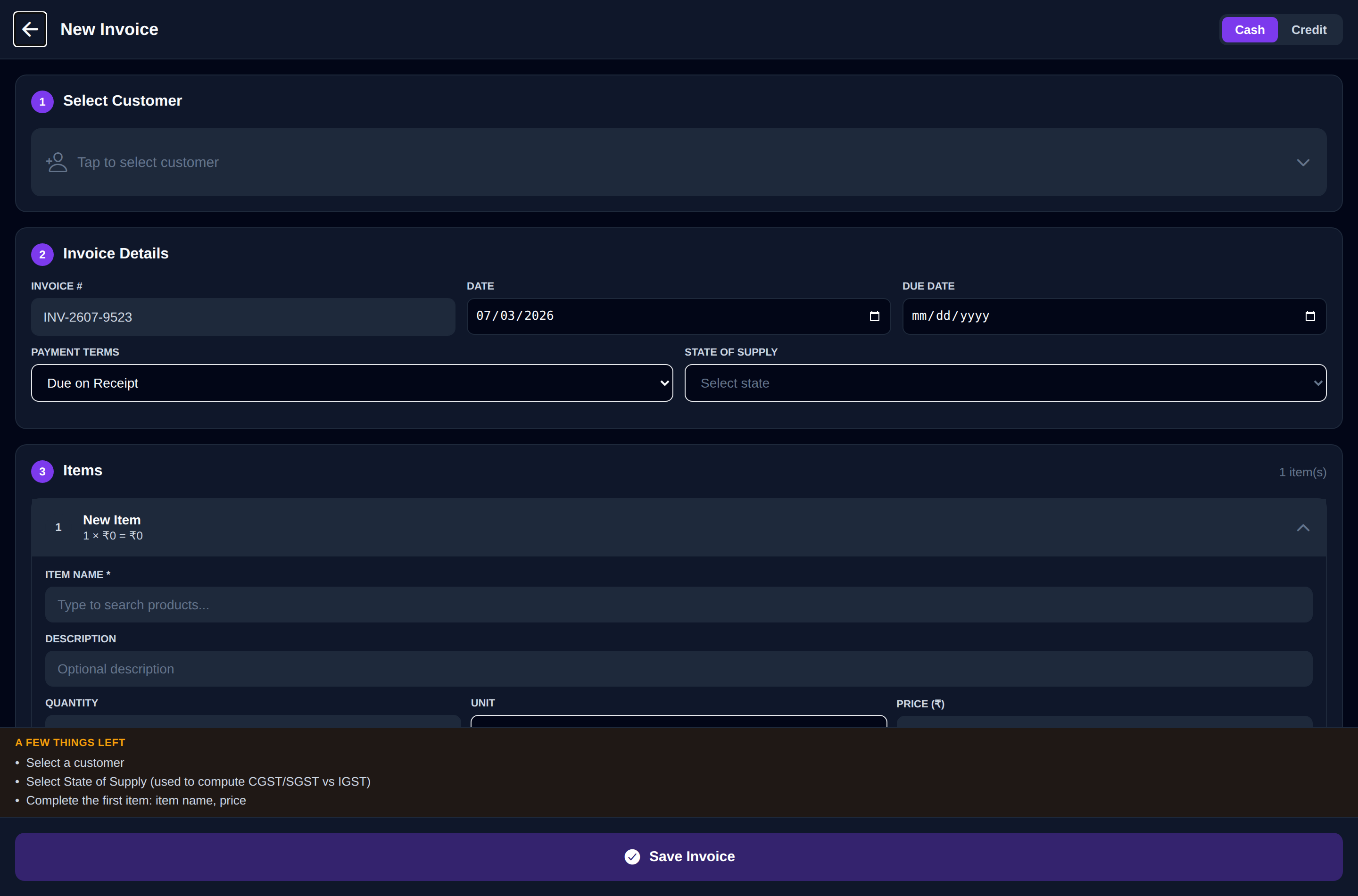
- 2Add a line item — type to use product-catalog autocomplete, or use Scan Item to capture one quickly.
- 3Set the GST % for that line. Repeat for each item, mixing rates as needed.
- 4Set the State of Supply for the invoice — this drives whether tax is intra-state or inter-state.
CGST/SGST vs IGST — derived automatically
You never pick the tax type by hand. InvoiceKaro compares the invoice's State of Supply with your business state (set in your business profile) and derives the correct split:
| Scenario | State of Supply vs your state | What InvoiceKaro charges |
|---|---|---|
| Intra-state sale | Same state | CGST + SGST (the GST % split in half) |
| Inter-state sale | Different state | IGST (the full GST % as one line) |
For example, an 18% line becomes 9% CGST + 9% SGST when you and the customer are in the same state, or a single 18% IGST line when they are in different states. Change the State of Supply and the breakdown re-derives instantly.
GSTIN on both sides
A compliant tax invoice carries the supplier's GSTIN and, where the buyer is registered, the buyer's GSTIN too.
- Your GSTIN comes from your business profile and prints on the invoice when the GSTIN display toggle is on.
- Your customer's GSTIN is saved on their customer record — an optional field, entered as-is. Add it on the customer (see Customers) and it appears on every invoice you raise for them.
The tax-breakdown toggle
Invoices have display-option toggles that control what prints — including logo, address, GSTIN, signature, terms, bank, UPI and the tax breakdown. Turn the tax-breakdown toggle on to itemise CGST/SGST or IGST below the subtotal; turn it off for a cleaner total-only layout.
How GST renders on the PDF and pay page
Whichever of the three PDF templates you choose — Classic, Modern or GST Pro — with your accent colour, the tax lines render the same way: each item shows its taxable value and rate, and the breakdown rolls up into CGST + SGST or IGST under the subtotal when the toggle is on.
The same totals appear on the public pay page behind every invoice's secure pay link, so your customer sees an identical GST-correct bill before they pay your UPI or bank directly. See Pay links and How your customers pay.